
When homeowners begin researching a new septic system, it’s natural to wonder what a standard septic tank design looks like. The reality is a little more nuanced.
Septic systems in British Columbia are designed around the property they serve. Soil conditions, available space, wastewater flow, groundwater and other site conditions can all influence the final design. Another important consideration is the level of wastewater treatment required.
This is where Type 1, Type 2 and Type 3 septic systems come in.
While the numbers may make them sound like three different versions of the same system, they actually refer to different levels of effluent treatment. Understanding the difference can make septic system design standards considerably easier to navigate.
What Are Septic System Design Standards?
Septic system design standards help ensure onsite wastewater is collected, treated and dispersed appropriately for the property and surrounding environment.
A septic system isn’t simply a tank buried somewhere in the yard. The complete system needs to account for the wastewater produced by the home, how that wastewater will be treated and how the resulting effluent will ultimately be dispersed into the soil.
That’s why two neighbouring properties don’t necessarily require identical systems. Depending on the site, the design may incorporate a Type 1, Type 2 or Type 3 treatment approach.
What Is a Type 1 Septic System?
A Type 1 septic system is the simplest of the three treatment levels. Wastewater from the home enters the septic tank. Inside the tank, heavier solids settle to the bottom while fats, oils and grease float towards the top.
The liquid effluent between these layers then leaves the septic tank and is directed towards the dispersal field. The important distinction is that there is no additional treatment plant treating the effluent before it reaches the soil.
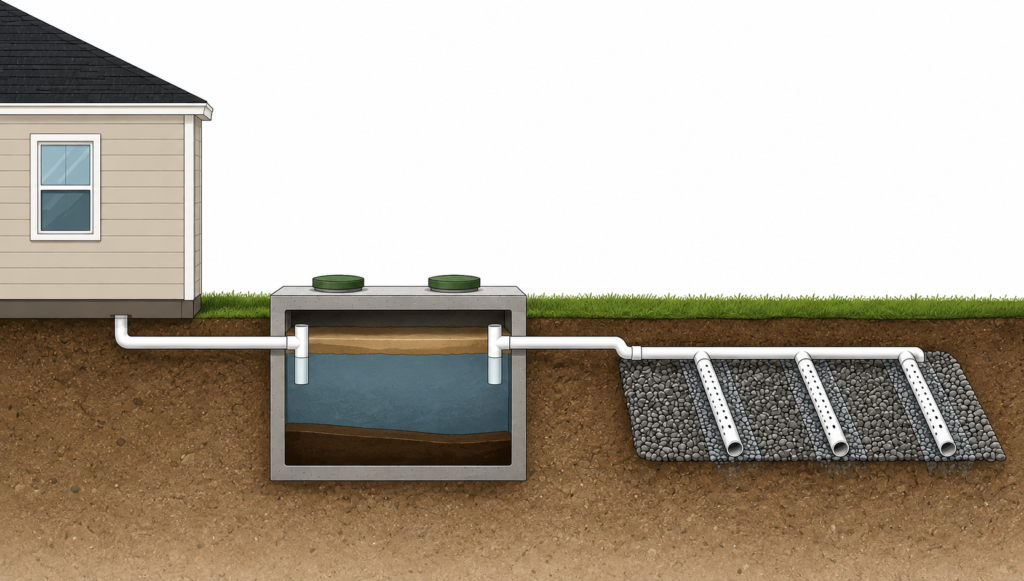
A Type 1 system may be appropriate when the property has suitable conditions for this type of design. It isn’t automatically the right choice simply because it is the least complex option; the site still needs to support it.
What Is a Type 2 Septic System?
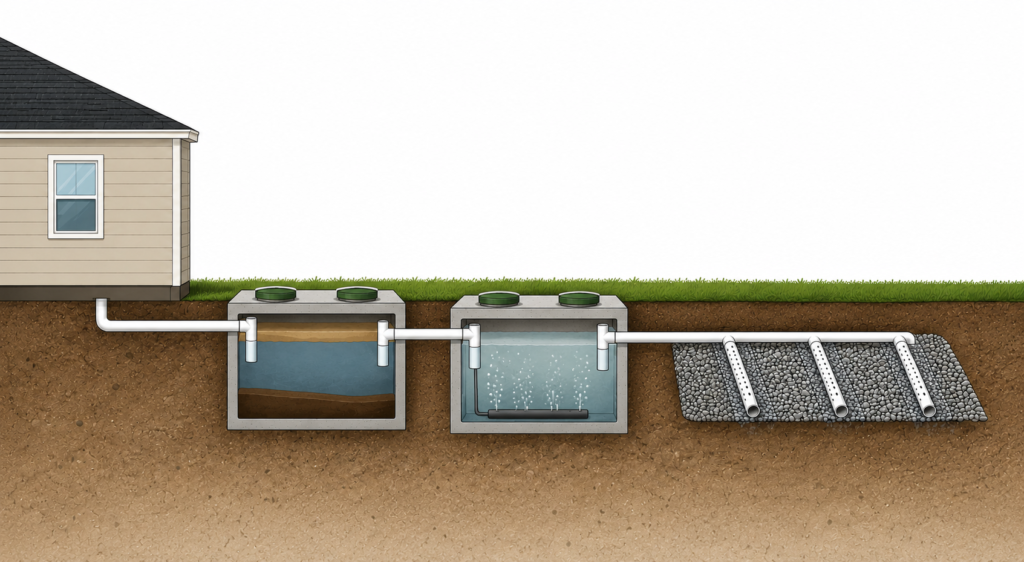
A Type 2 septic system adds another level of treatment. Wastewater still begins by entering a septic tank, but rather than sending the effluent directly from the tank towards the dispersal area, the system incorporates a treatment plant.
The treatment plant improves the quality of the effluent before it is applied to the soil. A common treatment process uses different bacterial environments to break down material within the wastewater.
One portion of the treatment process can be anaerobic, meaning it operates without oxygen. Another can use an aeration chamber, where a blower introduces air to create an environment for aerobic bacteria. Following treatment, a clarifier can allow additional solids to settle before the treated effluent moves onwards to the dispersal system.
The result is higher-quality effluent reaching the soil compared with Type 1 effluent.
Why Would a Property Need a Type 2 Septic System?
This is where septic system design becomes particularly property-specific.
A treatment system may be incorporated when the conditions of the site make additional wastewater treatment appropriate. Rather than looking at Type 2 as simply an “upgrade” from Type 1, it’s more useful to think about it as another design tool.
If a property can appropriately support a Type 1 system, adding unnecessary complexity doesn’t inherently make the septic system better. If the property requires additional treatment, however, a Type 2 system can provide that higher effluent quality before wastewater reaches the dispersal area.
The appropriate system comes back to the site assessment and design.
What Is a Type 3 Septic System?
Type 3 takes wastewater treatment another step further. The system still incorporates a septic tank and treatment process, but an additional disinfection stage is used to produce Type 3-quality effluent.
Two methods of doing this are UV disinfection and chlorination.
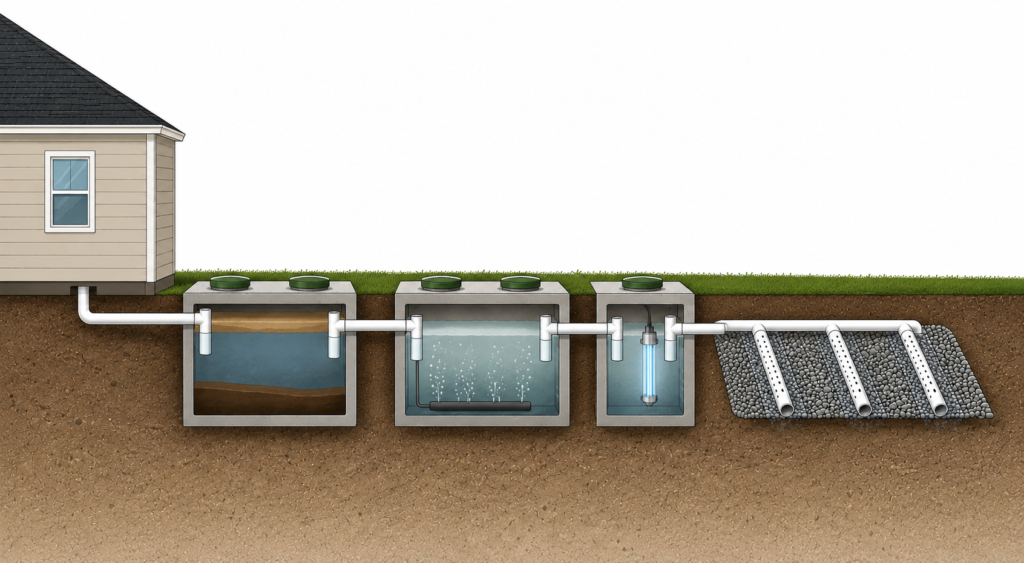
A simplified Type 3 system:
Because of the additional treatment requirements and complexity involved, Type 3 systems generally aren’t the first option considered when a less complex system can appropriately serve the property.
They also come with additional engineering, documentation and maintenance considerations.
Type 1 vs Type 2 vs Type 3 Septic Systems
The easiest way to understand the difference is to look at what happens to the wastewater before it reaches the soil.
| System | Basic Process | Treatment Level |
|---|---|---|
| Type 1 | Septic tank → dispersal field | Settling + separation in septic tank, without an additional treatment plant |
| Type 2 | Septic tank → treatment plant → dispersal field | Additional treatment produces higher-quality effluent |
| Type 3 | Septic tank → treatment plant → disinfection → dispersal field | Additional treatment + disinfection produces Type 3-quality effluent |
There is another useful distinction: the system classification and the actual quality of the effluent it produces aren’t necessarily the same thing.
Some treatment plants used within Type 2 systems can produce effluent that reaches Type 3 quality. That doesn’t necessarily mean the entire system is designed and classified as a Type 3 system.
For homeowners, this is another reason not to choose a system based simply on the Type 1, 2 or 3 label.
Is a Type 3 Septic System Better Than Type 1 or Type 2?
Not necessarily. It produces more highly treated effluent, but more treatment doesn’t automatically mean a better septic design for every property.
A good septic design provides the level of treatment appropriate for the conditions of the site while avoiding unnecessary complexity. A Type 1 system may be entirely appropriate for one property. Another may require Type 2 treatment. More challenging circumstances may make Type 3 treatment necessary.
The goal isn’t to install the highest-numbered system. The goal is to design the right system for the property.
Is There a Standard Septic Tank Design?
This is where the phrase standard septic tank design can be somewhat misleading. There are standards and requirements governing septic systems, but that doesn’t mean every property receives the same tank, field and layout.
A septic system design can be influenced by factors such as:
- Expected household wastewater flow
- Soil characteristics
- Available soil depth
- Property size + layout
- Available dispersal area
- Groundwater conditions
- Terrain + slope
- Existing and proposed structures
- The required level of wastewater treatment
The septic tank itself is also only one component of the complete onsite wastewater system. When designing a new system, we need to consider how everything works together — from the wastewater leaving the home to its treatment and eventual dispersal into the soil.
How Do We Determine Which Septic System a Property Needs?
It starts with the property. Before recommending a Type 1, Type 2 or Type 3 approach, the site needs to be assessed to understand the conditions we’re working with.
From there, the septic system can be designed around both the expected wastewater flow and the site’s ability to appropriately receive and disperse the effluent.
This is why we don’t begin a project by automatically choosing a particular septic system. We begin with the land, then design around what we find.
Septic System Design in British Columbia
In British Columbia, onsite wastewater systems need to meet provincial requirements and be planned by appropriately qualified professionals.
Working with a Registered Onsite Wastewater Practitioner (ROWP) helps ensure the site is properly assessed and the system is designed around the conditions of the property.
At Kerkhoff Excavating + Septic, we bring the septic design and excavation sides of the project together. That means we’re considering not only what works on paper, but how the system will actually be installed in the ground.
Which Septic System Is Right for Your Property?
If you’re planning a new septic system, you don’t need to decide whether you need Type 1, Type 2 or Type 3 before calling a septic professional.
That’s what the assessment and design process is for. The appropriate system depends on your property, soil conditions, wastewater requirements and other site-specific considerations. Sometimes the answer is relatively simple. Sometimes additional treatment is necessary.
Either way, good septic system design starts with understanding the property rather than forcing the property to fit a predetermined system.
Planning a New Septic System?
Every good septic system begins below the surface, with a clear understanding of the soil, the property and what the system needs to accomplish.
Kerkhoff Excavating + Septic provides professional septic system design and installation throughout the Fraser Valley and surrounding BC communities, combining Certified ROWP expertise with more than 21 years of excavation experience.
Contact Herman to arrange a site assessment and start planning the right septic system for your property.