
Living and working around Hope, you drive past the Hope Slide often enough that it can almost become part of the scenery.
Almost.
I’ve spent more than 20 years moving dirt, rock and everything in between with excavators. When that’s what you do every day, you get pretty good at looking at a pile and having a sense of what you’re dealing with. But every time I look at the Hope Slide, the scale is still hard to wrap my head around.
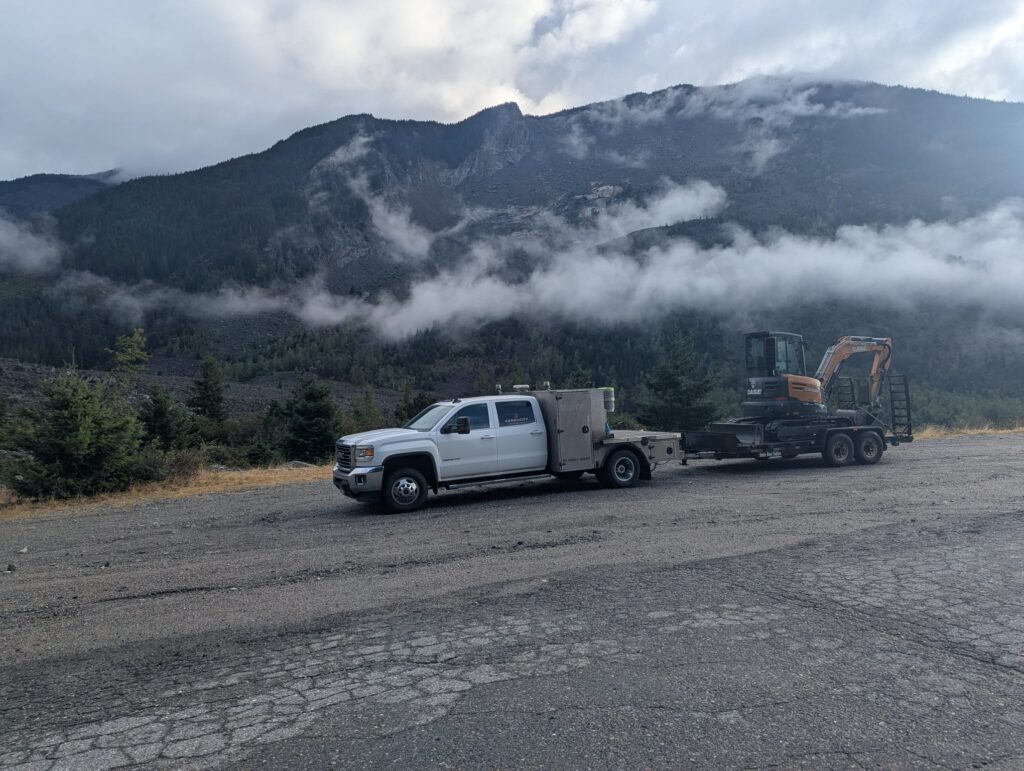
So I started wondering: if I parked my 165 excavator at the Hope Slide and did nothing but load trucks every day, how long would it actually take me to move it? The answer puts the size of that mountain into perspective.
A Brief History of the Hope Slide
In the early morning of January 9, 1965, a snow avalanche blocked the Hope-Princeton Highway in the Nicolum Valley, roughly 16 kilometres southeast of Hope. Vehicles stopped on the highway while waiting for the obstruction to be cleared.
At around 7 a.m., a much larger disaster followed.
A massive section of Johnson Peak gave way, sending rock and debris down the mountainside and across the valley. Four people were killed. The slide buried vehicles, displaced Outram Lake and destroyed nearly three kilometres of Highway 3.
The event was enormous enough to register seismically. For years, small earthquakes recorded around the time of the disaster were considered possible triggers. Later research challenged that interpretation, suggesting the seismic signals may actually have been generated by stages of the rock avalanche itself. The slope was already in a state of instability before the final collapse.
More than 60 years later, the scar it left on the mountain is still impossible to miss.
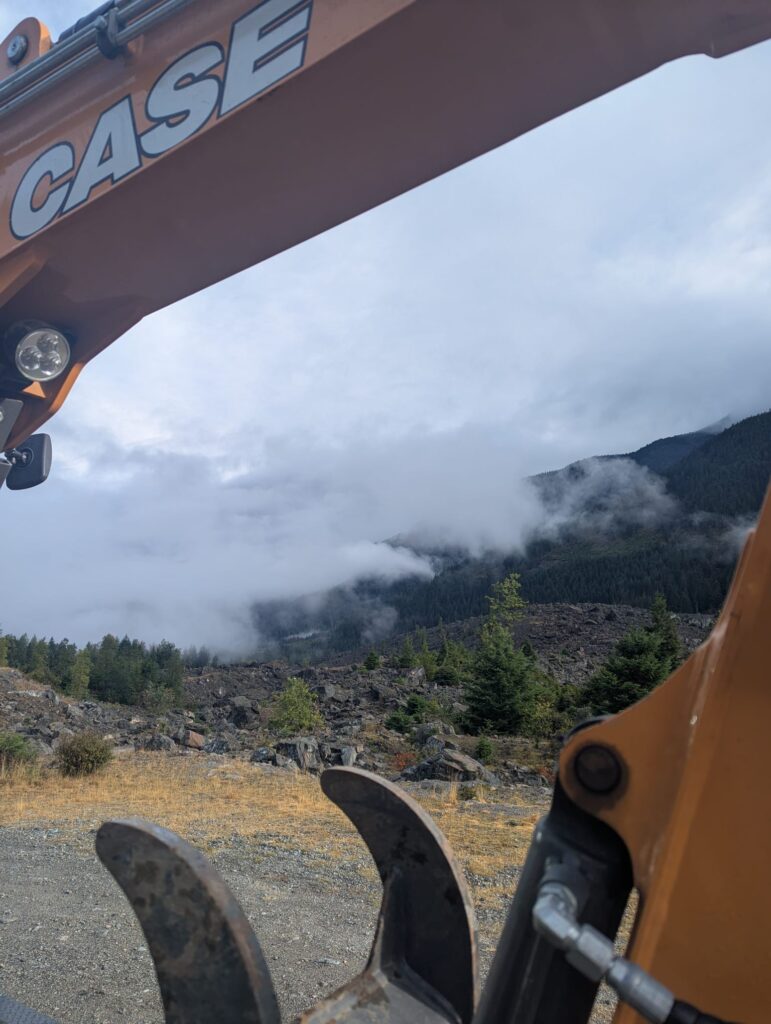
Just How Big Was the Hope Slide?
The accepted estimate is approximately 47 million cubic metres of material. BC Geological Survey literature describes it as the largest historical landslide recorded in British Columbia.
But 47 million cubic metres is one of those numbers that’s so large it doesn’t really mean much on its own.
The debris was reported to be up to 150 metres, or 500 feet, deep in places and roughly 1.2 to 2 kilometres wide. The rock avalanche crossed the valley with enough momentum to travel roughly 300 metres up the opposite side before coming back down.
That’s not a pile of rock. That’s a piece of a mountain. And that’s where I started thinking about it in terms I understand a little better: excavators and truckloads.
So, How Many Truckloads Are We Talking About?
Let’s make this practical. Say I’m sitting there in my 145 excavator, loading approximately 200 truckloads every day. If each truck carries about 14 tonnes, that’s: 200 loads × 14 tonnes = 2,800 tonnes moved per day.
Now we have to make an assumption because the Hope Slide is documented by volume, while the trucks are measured by weight. Different rock and debris have different densities, and excavated material also changes volume once it’s disturbed.
If we use a rough working estimate of 2 tonnes per cubic metre for the mixed rock and debris, those 47 million cubic metres would represent approximately:
94 million tonnes of material. That’s roughly: 6.7 million truckloads.
At 200 loads every single day, I’d have my work cut out for me.
I’d Be There for About 92 Years
At 2,800 tonnes per day: 94,000,000 ÷ 2,800 = approximately 33,571 working days.
If I worked every single day of the year, without taking a day off, without breaking down, without waiting for trucks, without weather delays and apparently without ever retiring: It would take about 92 years.
And that’s using an illustrative density assumption. If the average material were closer to 2.5 tonnes per cubic metre, the timeline would climb to roughly 115 years.
Either way, I’m not finishing the job.
And remember, that’s assuming 200 fully loaded trucks leave the site every day for decades. No traffic delays. No maintenance. No fueling downtime. No sorting material. No road construction. Just dig, load, haul, repeat.
Moving Dirt Changes the Way You Look at a Mountain
When you spend your working life excavating, numbers like cubic metres, tonnes and truckloads aren’t abstract. They’re your day. You know what 20 loads looks like. You know what 100 loads looks like. You know how much ground you can move during a good day when everything is running smoothly.
And then there’s the Hope Slide. Two hundred loads a day. Every day.
For roughly a century.
There’s something about putting it into those terms that makes the scale easier to appreciate. What happened in a matter of moments on January 9, 1965 would take one excavator and an endless line of trucks generations to undo.
Next time you’re driving Highway 3 and looking up at that massive scar on the mountain, take another look.
About the calculation
The 47 million m³ figure comes from published geological and BC government sources. The 92-year estimate is intentionally a thought experiment, not an engineering estimate. It assumes an average bulk density of 2 tonnes/m³, 14 tonnes per truck, 200 loads per day and operation 365 days per year. Actual material density, swell, equipment productivity, truck capacity and site conditions would substantially affect a real-world calculation.